The success of office spaces is now determined not only by the arrangement of desks or the quality of coffee, but also by the invisible infrastructure that supports employees' concentration, energy levels, and well-being. The office ventilation system is key to this: it works well when it provides stable, fresh air all day long, reduces CO₂ load in the meantime, and quietly, almost imperceptibly maintains comfort. Modern, is based on heat recovery building solutions have been designed for this purpose: they provide continuous air exchange with minimal heat loss, thus combining well-being and productivity with energy efficiency.
The office environment is diverse: open office, focus rooms, meeting rooms, collaboration spaces, kitchen corner, server room – each represents a different load profile. An efficient ventilation system recognizes these patterns and regulates air delivery accordingly. The goal is twofold: on one hand, to support cognitive performance (with stable CO₂ levels and appropriate oxygen levels), and on the other hand, to 16. draft-free blowing ensure that ventilation is never more distracting than the monotonous hum of typing. A good system is not a compromise: it is simultaneously quiet, economical, and effective.
Noise comfort in open offices: quiet ventilation system and optimal air distribution
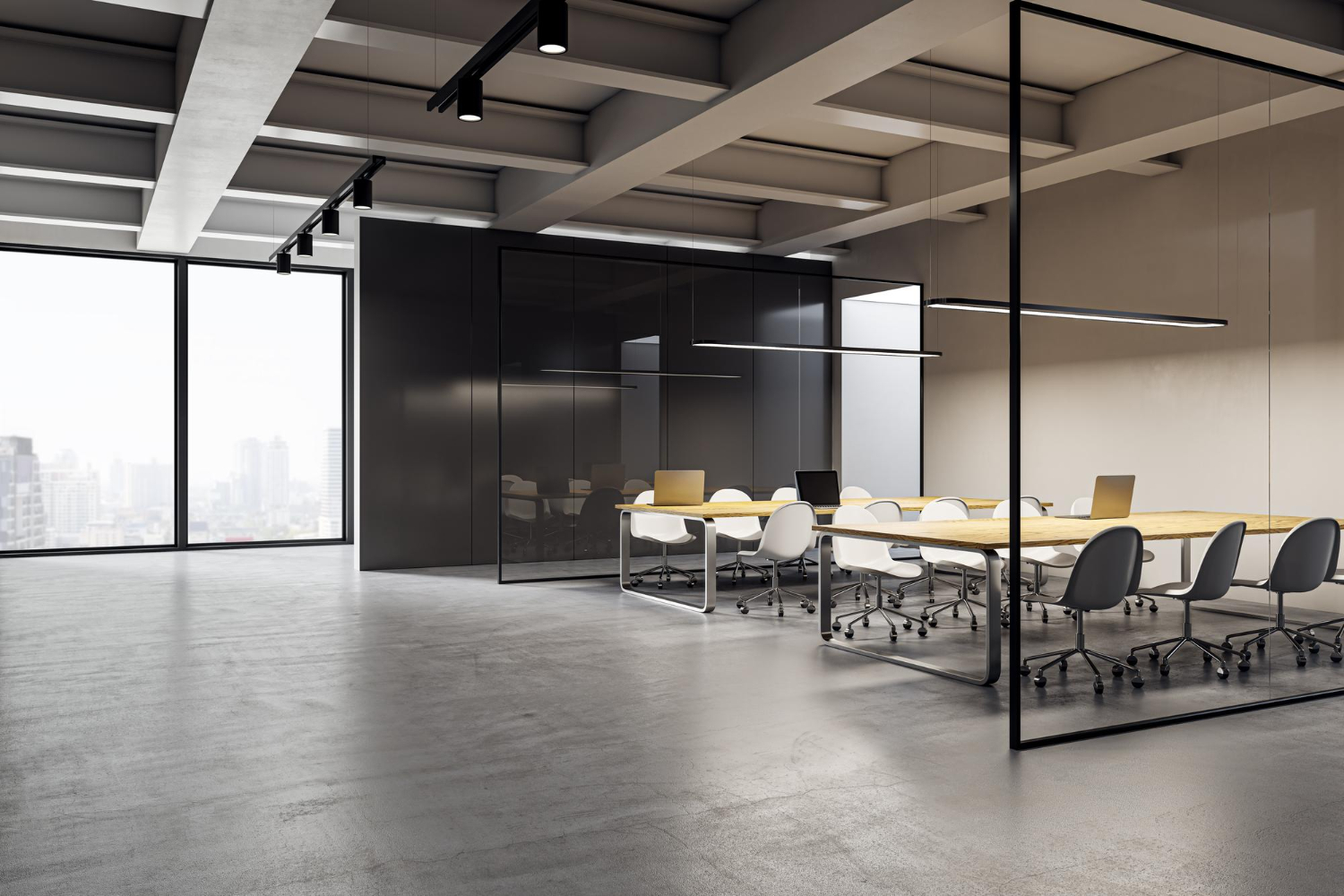
In open offices, the „quality” of air and silence go hand in hand. It is of no use to receive fresh air if the system's noise drowns out our thoughts; and vice versa: deafening silence is not valuable if the accumulating CO₂ makes us tired. Quiet, intelligent ventilation is determined by the mode and speed of airflow. The coordinated design of ducts, fittings, sound dampeners, and diffusers allows the supplied air to enter the space at low exit speed, without draft sensationinto the space. Thus, those sitting at the desks do not feel a „striped” cold air stream, but rather a uniform, pleasant refreshment.
The other secret of noise reduction is partial load operation: modern, EC motor-driven The fans only rotate as much as necessary – this has two benefits. On one hand, the operation is significantly quieter, and on the other hand, we save energy. When distributing air, it is worth separating the needs of different zones (open office, meeting room, lounge): focus areas, for example, are sensitive to low background noise, while collaborative areas have greater load fluctuations, so it is important that the ventilation can flexibly switch up and down. Heat recovery central units (HRV) support this best: they continuously provide fresh air while recovering the heat content of the outgoing air and transferring it to the incoming air – thus, there is no need to compromise between comfort and cost.
Maintenance is also part of noise comfort: the condition of the filters. Pressure difference monitoring and operating hour-based alerts indicate when replacement is due. A fresh filter means lower pressure loss and smaller fan speed – that is condition, for example, directly affects pressure loss and fan speed. A clean filter is not only more hygienic but also provides quieter operation. In Vents solutions, filter replacement and cleaning are accessible, easily documentable processes; we have written detailed guides about this in the on the blogWe wrote detailed guides.
Noise comfort
Quiet ventilation in open offices
In open offices, air quality and silence together affect performance. A well-designed ventilation system does not create drafts but refreshes the space with even, low-speed air distribution.
- low exit speed injection
- EC motor fans in partial load operation
- zoned air distribution for focus and collaboration areas
Quiet ventilation is not a luxury but a basic requirement for concentrated work.
CO₂ thresholds and cognitive performance: design considerations for office ventilation systems
CO₂ is one of the most important indicators of indoor load. It creeps up unnoticed in the office: every meeting, every joint brainstorming raises the level, and with it, concentration may decrease, drowsiness and the likelihood of headaches may increase. A well-functioning office ventilation system optimizes not for average but for real-time demand: CO₂ sensors measure the actual load and regulate air delivery. The result: a stable, „alert” environment where the brain does not tire due to air quality but can concentrate on completing the task.
The design is based on two main pillars from the perspective of cognitive performance. The first is zoning: a different profile is needed for meeting rooms, where many gather for a short time, and another for the open space, where the load is more continuous. The second is continuous regulation: the system is effective when it monitors not only CO₂ but also humidity and – where necessary – temperature, and makes decisions based on their interrelations. The HRV technology is doubly advantageous here: the fresh air we receive while the heating-cooling energy significant part remains in the space due to heat recovery. Thus, CO₂ control does not involve unnecessary energy consumption.
Consistency is key in terms of cognitive performance. Daily fluctuations – morning peak, post-lunch „trough,” afternoon meeting overload – each represent a microclimate change. It is impossible to track this with manual switching; however, automated, sensor-controlled HRV systems are precisely designed for this. The air quality thus becomes an „invisible service”: always present, regardless of the load.
CO₂ and focus
Why CO₂-controlled ventilation is crucial in the office
The rise in CO₂ levels subtly reduces concentration.
- stable oxygen levels even during meetings
- less drowsiness and headaches
- consistent performance throughout the day
BMS integration: CO₂/humidity sensors, timing, presence-based automation
Office ventilation is not a lone warrior: it works best when it is part of the overall building management. The BMS integration (Building Management System) allows the ventilation to „breathe” together with the lighting, shading, and heating-cooling system. If a presence sensor in the meeting room turns on the light, at the same moment the ventilation can also increase, and then at the end of the meeting – according to the timing set – it can even perform post-ventilation before returning to the baseline. The CO₂ and humidity sensors data can be easily tracked on the BMS interface; thus, the system not only reacts immediately but also shows trends: which space was loaded when, how the peaks develop, where adjustments need to be fine-tuned.
A presence-based automation particularly useful alongside the variable utilization of offices. With hybrid work arrangements, the number of people fluctuates in many places; it would be unnecessary to maintain a fixed ventilation profile. Smart HRV solutions provide exactly this answer: if a wing is empty, they reduce; if the space suddenly fills up due to a workshop, they ramp up. This flexibility not only enhances comfort but also reflects on cost – less waste, more meaningful, targeted operation.
The advantage of integration is that maintenance is also data-driven possible. Filter replacement can be adjusted not to a calendar but to actual load, and fault signals do not come from a „black box,” but in easily interpretable message forms. Thus, the system remains reliable, predictable, and stable in the long term – just as we expect from a productivity-optimized office. Further materials on the technical details of BMS connection and Vents solutions have been on the blogcollected.
Automation
BMS integration for intelligent office ventilation
Office ventilation is truly effective when it is part of the.
- CO₂ and humidity sensor-based regulation
- occupancy-driven air supply
- timed post-ventilation in meeting rooms
- data-driven maintenance and operation
Silence, fresh air – this is how ventilation becomes the engine of a productive office
A well-designed office ventilation system thus provides three things at once: silence, fresh air modern technologies energy efficiency. In open spaces, quiet operation and careful air distribution create the conditions for focus; in meeting rooms and focus rooms, CO₂-controlled regulation maintains cognitive performance; and BMS integration ties all this together into a flexible, data-driven operation. If you combine all this with heat recovery, comfort does not cost more: fresh air does not equal throwing away heat.